On-prem AI coding does not solve the architecture question
Hybrid and on-prem AI coding agents may unlock adoption in regulated companies. They still need architecture, boundaries, review and operational design.
Kyluke McDougall
Software Architect & Founder
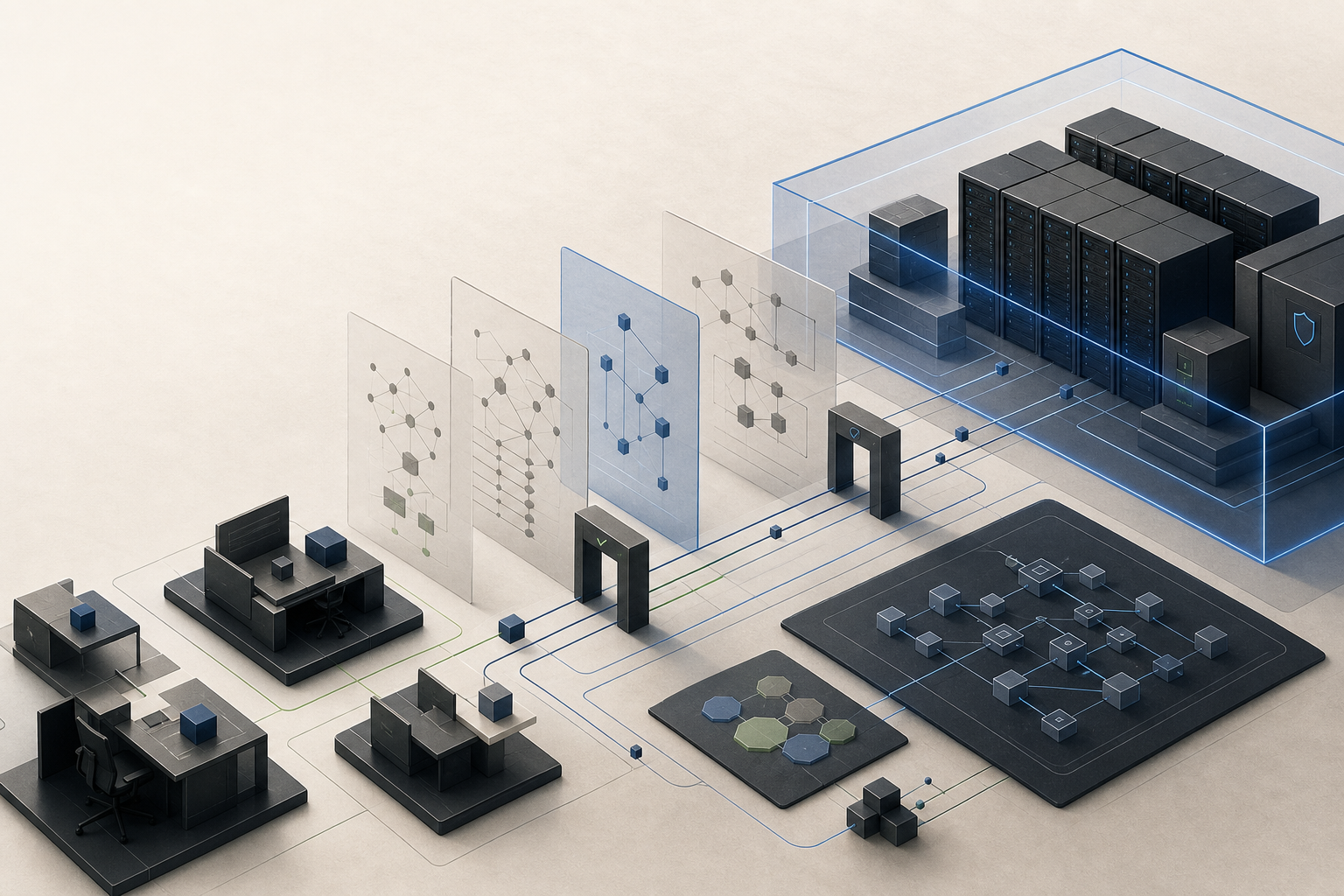
AI coding agents are moving closer to enterprise infrastructure.
That matters.
The current discussion around OpenAI and Dell bringing Codex into hybrid and on-premises environments is not just another vendor announcement. It points to a real adoption barrier for serious companies: many teams cannot casually send proprietary code, internal documentation, customer-adjacent context or regulated workflows into public cloud tools.
For banks, manufacturers, healthcare companies, public-sector suppliers and many German Mittelstand businesses, this has been one of the hard limits of AI-assisted development. The argument was not always that AI coding tools were useless. The argument was simpler:
We cannot put that data there.
Hybrid and on-prem deployment changes that conversation. It makes AI coding agents more plausible for environments where data residency, security policy, customer contracts and internal risk management matter.
But it does not remove the architecture question.
In fact, it makes the architecture question more important.
Private deployment is not the same as production readiness
Moving an AI coding agent closer to company infrastructure solves one class of problem.
It can reduce exposure to public cloud services. It can make data governance easier to reason about. It can fit better with internal security policies. It can support regulated teams that need stronger control over where source code, logs, prompts and documents are processed.
Those are meaningful improvements.
But private deployment does not automatically answer the questions that decide whether AI-assisted development is safe and useful in practice:
- Which repositories can the agent read?
- Which systems can it call?
- Which data may enter prompts or context windows?
- Which actions require human approval?
- Who reviews generated changes?
- How are sessions logged?
- Where do secrets live?
- What happens when the agent makes a plausible but wrong change?
- Who owns the operating model after the pilot?
Those questions do not disappear because the tool runs on preferred infrastructure.
They move inside the organisation.
That is why founders, CTOs and product owners should treat this shift carefully. Hybrid AI coding is not a free pass to let agents roam through internal systems. It is an opportunity to design a better delivery environment from the start.
The useful shift: from tool adoption to system design
Early AI coding adoption was often individual.
A developer installed a tool. A founder tried an app builder. A product manager used an assistant to sketch a workflow. A team experimented with Cursor, Claude Code, Codex-style agents, Lovable, Replit or other tools to see what became faster.
That phase is useful. It teaches teams where AI helps and where it creates noise.
Enterprise adoption is different.
Once AI coding enters company infrastructure, the question is no longer “which tool writes code fastest?” The better question is:
What system are we building around AI-assisted development?
That system includes the model and interface, but also:
- repository structure;
- documentation quality;
- architecture boundaries;
- test strategy;
- access control;
- code review;
- deployment gates;
- audit trails;
- incident response;
- cost management;
- ownership.
The agent is only one part of the delivery system.
This is where many AI rollouts become disappointing. Companies buy access, run a few impressive demos, then realise that the hard work is not prompting. The hard work is giving the agent the right context, limiting the wrong authority, measuring outcomes, and deciding where human judgement stays mandatory.
On-prem or hybrid infrastructure does not reduce that work.
It makes it worth doing.
Why this matters in the German market
German companies are often cautious with new software development practices for good reasons.
They operate under customer contracts, data-protection expectations, sector rules, works councils, supplier obligations and long-lived operational processes. A manufacturing company may run software that touches production, logistics or quality assurance. A SaaS company may handle customer data under strict contractual terms. A Mittelstand business may have systems that were not designed for fast-moving AI tools, but are still critical to daily work.
In that context, “the AI tool is now available on-prem” is not the final argument.
It is the beginning of a more serious evaluation.
For many teams, the right answer may be staged:
- use public SaaS AI tools for low-risk exploration and throwaway prototypes;
- use controlled cloud environments for normal product development where data classification allows it;
- use hybrid or on-prem setups for sensitive repositories, regulated workflows or internal systems;
- keep certain production systems off-limits until architecture, logging and review are ready.
This is not bureaucracy for its own sake.
It is categorisation.
Not every repository carries the same risk. Not every product area needs the same controls. Not every agent workflow deserves the same permission level. A marketing site, an internal dashboard, a billing system and an industrial control integration should not be treated as the same kind of software just because the same AI coding agent can technically work on all of them.
Good AI adoption starts by naming those differences.
What should be decided before an enterprise rollout
The practical work starts before the tool is widely enabled.
A serious team should decide at least seven things.
1. Repository and system boundaries
The first boundary is simple: where is the agent allowed to work?
That question should be answered by risk, not convenience. Some repositories are suitable for broad AI-assisted development. Others need read-only access, narrower permissions or no agent access at all until the surrounding controls exist.
For example, a design-system package may be a good candidate for assisted refactoring. A billing service may require a stricter workflow. A data migration tool may need human approval for every generated change. A production operations repository may need session logging and separation from normal feature work.
The point is not to block AI.
The point is to match permission to responsibility.
2. Context curation
AI coding quality depends heavily on context.
In a private environment, it becomes tempting to give the agent everything: all documentation, all repos, all tickets, all internal notes, all logs. That may feel powerful, but it can create confusion, leakage and poor decision-making.
Teams need a context strategy.
Useful context includes current architecture decisions, coding standards, domain language, test commands, deployment rules, API contracts and known non-goals. Less useful context includes stale plans, contradictory documents, outdated tickets and sensitive data that the agent does not need.
Better context is not always more context.
Better context is selected, current and tied to the task.
3. Review gates
AI-generated code should not skip review because it was produced quickly.
If anything, faster generation increases the need for deliberate review. The reviewer is no longer only checking syntax or style. They are checking whether the change fits the product, respects the architecture, handles edge cases and avoids expanding hidden complexity.
For low-risk work, review may be lightweight. For sensitive areas, review should be stricter: tests, architecture owner approval, security checks, migration review or staged deployment.
The review model should be designed before adoption reaches high volume.
Otherwise the team gets speed first and quality debt second.
4. Logging and auditability
Enterprise teams need to know what happened.
That includes prompts, tool calls, file edits, generated diffs, approvals, failed commands and final decisions. Not every detail needs to be kept forever, but the organisation should have enough traceability to answer practical questions:
- Why was this change made?
- Which context did the agent use?
- Did a human approve it?
- Which tests ran?
- Which systems were touched?
- Was sensitive data exposed unnecessarily?
Auditability is not only a compliance feature.
It is how teams debug their own AI development process.
5. Secrets and credentials
Private deployment does not make secrets safe by default.
Agents may read files, run commands, inspect environment variables, call tools or generate configuration. If secrets are scattered through local environments, build logs or old documentation, the agent may encounter them.
A good rollout separates credentials from context. It uses short-lived access where possible, avoids broad machine-level authority, and treats generated code that touches secrets as high-risk work.
The question is not only “does the vendor protect our data?”
The question is also “have we protected ourselves from our own development environment?”
6. Measurement
AI coding should be measured by delivery outcomes, not excitement.
Useful measures include cycle time, review load, escaped defects, rework, test coverage, lead time for specific task types, maintenance burden and developer satisfaction. Token usage or number of generated lines can be useful operational data, but they are weak business metrics on their own.
The best rollouts define where AI is expected to help:
- faster prototype exploration;
- more complete tests;
- safer refactoring;
- better documentation;
- reduced repetitive implementation work;
- quicker internal tool delivery;
- cleaner migration planning.
If the expected outcome is not named, the rollout becomes hard to judge.
7. Ownership
Someone must own the system.
Not the vendor relationship. Not only the licenses. The actual AI-assisted delivery model.
That ownership includes maintaining repo instructions, updating context, deciding permission tiers, reviewing incidents, improving prompts and templates, tracking costs, and making sure the workflow still serves the product.
Without ownership, AI coding adoption becomes a collection of habits.
With ownership, it can become a delivery capability.
On-prem AI can still create faster technical debt
The biggest misconception is that private infrastructure turns AI coding into a solved problem.
It does not.
An on-prem agent can still produce weak abstractions. It can still misunderstand the domain. It can still introduce unnecessary dependencies. It can still change the wrong layer. It can still generate tests that prove little. It can still make a codebase harder to maintain while keeping all data inside the building.
That last part matters.
Keeping data private is important. But a private mess is still a mess.
The business risk is not only data exposure. It is also the creation of systems that no one can confidently operate, extend or hand over.
This is why architecture-first delivery matters more as AI gets closer to production systems. The speed is useful when it accelerates a clear direction. It is dangerous when it accelerates ambiguity.
A practical adoption path
Teams do not need to solve everything before using AI coding tools.
They do need a staged path.
A sensible approach looks like this:
- Inventory current AI usage. Which tools are already being used, by whom, on which repos and with what data?
- Classify repositories and workflows. Separate low-risk, normal-risk and sensitive areas.
- Define allowed use cases. Be explicit about where AI can generate code, tests, documentation, migrations or operational scripts.
- Design review gates. Match review depth to product risk.
- Clean up context. Give agents current architecture notes, commands and constraints instead of dumping everything into reach.
- Separate secrets and authority. Avoid permanent broad credentials and uncontrolled system access.
- Measure outcomes. Track whether AI actually improves delivery quality, not just apparent speed.
Only after that does the deployment model become a good strategic question.
Public cloud, controlled cloud, hybrid and on-prem can all be valid in different parts of the same organisation. The mistake is treating infrastructure choice as the whole adoption strategy.
It is only one layer.
Where McDougall Digital can help
At McDougall Digital, we see this shift as a useful sign.
AI-supported software development is becoming more realistic for serious products, not less. But the winners will not be the teams that simply install the most powerful agent closest to their data. The winners will be the teams that know which work the agent should do, which work needs human judgement, and which architecture boundaries must not be blurred.
We can help teams:
- assess where AI coding tools fit in their current delivery process;
- separate prototype, internal-tool and core-product workflows;
- design repository and permission boundaries;
- prepare architecture notes and context that agents can use safely;
- review AI-generated systems before they become operational dependencies;
- define review, testing and deployment gates around AI-assisted work;
- choose a practical public, hybrid or on-prem adoption path.
The goal is not to slow teams down.
The goal is to make the new speed usable.
The core message
Hybrid and on-prem AI coding is a serious step forward for enterprise adoption.
It may unlock teams that could not responsibly use public cloud AI tools for sensitive software work. It may make AI-assisted development more compatible with regulated industries, German market expectations and internal security policies.
But it does not replace architecture.
It does not replace product judgement.
It does not replace review, testing, documentation, permissions or operational responsibility.
AI coding agents are becoming part of the development environment. That is exactly why teams should design the environment before they depend on it.
This article was created with the help of AI. McDougall Digital is responsible for its content.