Claude Helped Breach OpenAI. The Real Story Is That Exploitation Got Cheaper
A public image upload became internal repository access. The lasting lesson is how AI changes exploit economics—and which architecture controls still stop the chain.
Kyluke McDougall
Software Architect & Founder
“Claude hacked OpenAI” is an irresistible headline.
It is also the wrong lesson.
The event disclosed this week was authorised security research, not an autonomous model deciding to attack another AI company. Three researchers at Hacktron AI used Claude models, their own expertise and a responsible disclosure process to find and chain two vulnerabilities. They stopped after demonstrating impact with a harmless pull request and reported the issues.
The chain is still remarkable:
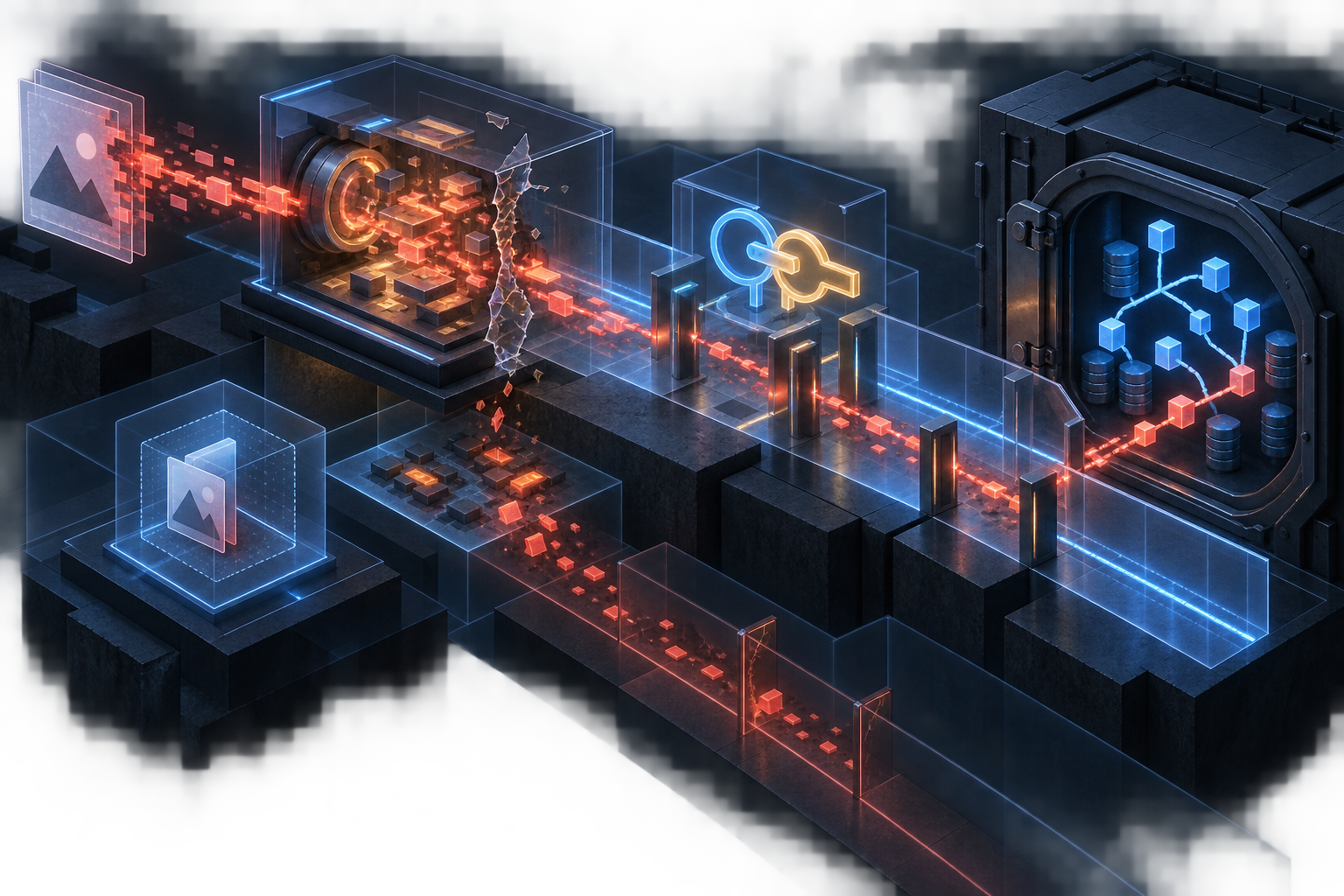
HEIF image upload → memory corruption → code execution → SSO failure → employee ChatGPT and Codex access → connected GitHub organisation → internal pull request.
According to Hacktron, the work from initial discovery to internal repository access took less than 72 hours. Its broader two-month research campaign cost under $3,000 in model tokens. The researchers say skilled human guidance remained important, but newer models compressed work that previously demanded much more time and scarce exploit-development expertise.
That is the client-relevant story.
AI is not making established security controls obsolete. It is making the time between a weakness and a practical exploit shorter. Companies can no longer treat technical complexity as an informal safety margin.
For founders, CTOs and product teams, the response is not to panic about “AI hackers”. It is to revisit the architecture boundaries that allowed one hostile image to travel so far.
What reportedly happened
Hacktron’s technical write-up describes two separate weaknesses joined into one high-impact path.
The first was in image processing.
OpenAI’s public community forum used Discourse. HEIC and HEIF uploads followed a path through ImageMagick, which relied on the native libheif library to decode the files. Hacktron says its researchers identified missing security fixes in the packaged library and developed a heap-buffer-overflow exploit that produced code execution during image decoding.
This is an old class of problem. Native media parsers process complicated, attacker-controlled binary formats. They have repeatedly produced memory-safety vulnerabilities.
The new element was the economics of turning the bug into a reliable exploit.
Hacktron says Claude Opus 4.8 helped identify the missing fixes and build an initial exploit, but struggled to make it reliable with ASLR enabled. When Claude Opus 5 became available, the researchers gave it the same problem. They report that it produced a working ARM64 exploit in roughly three hours and was then used to adapt the technique for the x86-64 environment used by Discourse.
The second weakness was in identity.
Code execution on a public forum should not automatically grant access to a company’s core AI products or source repositories. But the compromised forum sat inside an OpenAI identity flow. Hacktron reports that an OpenAI SSO issue allowed the forum compromise to become access to an employee’s ChatGPT and Codex account.
That account had a connected GitHub integration.
To demonstrate impact without reading internal source code, the researchers say they instructed the employee’s Codex account to open a harmless pull request in OpenAI’s internal monorepo. They then stopped testing and reported the chain.
Hacktron says OpenAI fixed the SSO issue roughly 14 hours after the submission. Discourse prepared its fix by the following Monday and added image-processing sandboxing as defence in depth. OpenAI later paid a $6,500 bounty for the OpenAI-side finding.
Those details matter because they correct two misleading interpretations.
First, this was not a malicious breach campaign. It was coordinated research and disclosure.
Second, Claude did not perform the entire operation independently. Human researchers selected the target, guided the models, validated results, made judgement calls and handled disclosure. AI amplified capable people; it did not remove them from the loop.
The real shift: exploit development becomes more economical
Software teams have never been able to claim that complexity is a security control.
In practice, however, complexity has provided some protection.
A memory-corruption bug in an obscure native dependency may be publicly visible, yet converting it into a reliable exploit across an unfamiliar deployment can require specialised knowledge, target-specific testing and weeks of work. Many attackers focus on cheaper routes instead: stolen credentials, exposed admin panels, unpatched known vulnerabilities and social engineering.
AI changes that calculation.
It can inspect unfamiliar code, compare versions, generate test cases, reason about crash behaviour, adapt an exploit between architectures and maintain momentum across many parallel attempts. A skilled researcher can delegate more of the laborious search and adaptation while retaining control of strategy and validation.
Hacktron’s numbers are its own vendor claims, not a universal benchmark. But the direction is credible: some expert work is being converted into model inference and iteration.
That changes threat modelling in three ways.
More vulnerabilities become worth operationalising
A bug that was too awkward to exploit at scale may become commercially attractive when an agent can handle much of the adaptation.
The question is no longer only whether a weakness exists. It is how quickly a motivated team can turn it into a repeatable path against your environment.
Attackers can test more paths in parallel
The disclosed campaign reportedly covered multiple organisations and deployments. AI assistance makes it easier to explore different versions, formats, architectures and mitigations without assigning a separate human specialist to every branch.
Defenders should assume that unusual configurations and less-popular dependency versions will receive more attention than they did before.
Time-to-exploit can approach time-to-patch
The vulnerable upstream code had reportedly changed without being clearly labelled as a security fix or assigned a CVE. That contributed to delayed downstream backports.
This is a dangerous gap. Traditional patch workflows often wait for a named vulnerability, a severity score and a vendor advisory. AI-assisted research can move from an ambiguous code change to a working exploit before that administrative machinery catches up.
One image reached too many trust domains
The most useful way to analyse the incident is not as one dramatic vulnerability. It is as a sequence of controls that either failed or were absent.
A hostile file reached a native decoder. The decoder was not sufficiently isolated. Code execution landed inside a service connected to a broader identity boundary. The resulting session could reach powerful AI tools. Those tools held a connector into source control.
No individual convenience explains the whole impact.
The impact came from composition.
That is a common architecture failure in serious products. Teams review components independently:
- the forum is “only a community site”;
- SSO reduces account friction;
- a GitHub connector makes the coding assistant useful;
- image conversion supports customer uploads;
- a shared employee identity simplifies access.
Each decision can look reasonable alone. Together they create a path from public input to internal authority.
Architecture work is largely the discipline of seeing that path before an attacker does.
Seven controls worth checking now
The right response is broader than updating one package.
1. Reduce parser exposure
Every accepted file format increases attack surface.
If a product does not need HEIF, AVIF, SVG, PDF or another complex format, do not process it merely because a library supports it. Validate by content, not only filename or MIME header. Set strict limits on dimensions, layers, metadata, decompression and processing time.
Convert untrusted media at the edge into a narrow internal format, then discard the original from trusted processing paths.
2. Sandbox hostile processing
Assume that media parsers, document converters and archive tools will eventually contain another memory-safety bug.
Run them outside the main application process, with no ambient credentials, no access to internal networks and a read-only filesystem where practical. Use ephemeral workers, resource limits and a minimal syscall and package surface. Treat a parser crash as a contained job failure, not a foothold inside the application.
Discourse’s addition of ImageMagick sandboxing is the durable lesson here. Patching addresses today’s bug. Isolation limits tomorrow’s.
3. Patch dependencies by security state, not version aesthetics
The disclosed libheif issue illustrates a difficult supply-chain reality: a distribution package can have an older version number with backported fixes, while a newer-looking package may still miss a security-relevant commit.
Teams need to know which patched state is actually deployed.
Track operating-system advisories, base-image rebuilds and transitive native libraries. Rebuilding an application container may be necessary even when no application dependency changed. Record the resulting package inventory so incident response can answer which systems processed untrusted files with which decoder.
4. Treat SSO as a blast-radius design
Single sign-on improves usability and centralises account controls. It also links systems that may have very different exposure.
A public forum, support portal or marketing tool should not automatically receive a session with the same authority as core engineering systems. Use audience-restricted tokens, separate clients, short lifetimes and explicit re-authentication for sensitive products. Do not let a token minted for one service become useful to another unless that relationship is intentional and tested.
Ask a blunt question:
If this peripheral application is fully compromised, which employee sessions and connected systems become reachable?
That is the real SSO boundary.
5. Scope AI connectors separately
An AI assistant connected to source control, email, Slack or cloud tools can become a powerful bridge.
Do not inherit every permission from the human account. Give the connector a dedicated identity, limited repositories, read-only access by default and short-lived credentials. Require review for writes. Separate internal and customer environments. Log which tool initiated each action.
The value of an agent comes from useful access. The safety of the agent comes from bounded access.
6. Detect exploitation attempts, not only successful compromise
Hacktron reports sending many images and repeatedly crashing processors during its broader research, with little apparent detection.
Repeated decoder crashes, unusual format combinations, bursts of malformed uploads and workers restarting around one account are security signals. Centralise them. Correlate them with identity events and connector use. Alert when a public-facing service is followed by unusual token issuance, account switching or source-control activity.
Observability should connect the chain, not produce five unrelated logs that nobody reviews together.
7. Rehearse cross-vendor response
The demonstrated path crossed an open-source library, a distribution package, ImageMagick, Discourse, an identity provider, an AI product and GitHub.
No single vendor owns the entire incident.
Your response process should be able to identify the entry point, contain sessions, disable connectors, rotate credentials, rebuild affected images and preserve evidence while different suppliers investigate. Ownership must be defined before a Sunday-night disclosure arrives.
What AI changes—and what it does not
AI increases both offensive and defensive capacity.
Attackers can inspect more code and adapt exploits faster. Defenders can review dependencies, fuzz parsers, analyse crashes, generate detection ideas and test controls with the same class of tools.
The advantage will not come from simply possessing an AI subscription. Both sides have one.
It comes from the surrounding operating model.
A company with current inventories, isolated processing, constrained identities, observable connectors and rehearsed response can use AI to shorten remediation. A company with shared credentials, opaque dependencies and flat trust boundaries gives AI-assisted attackers more leverage.
The fundamental controls remain familiar:
- minimise exposed functionality;
- patch what actually runs;
- isolate dangerous work;
- separate identities and audiences;
- grant least privilege;
- verify resolved state;
- monitor boundary crossings;
- respond across the whole chain.
AI makes the absence of those controls easier to exploit. It does not make them less effective.
Do not rely on “too difficult to exploit”
The most important sentence in Hacktron’s disclosure is not that one model outperformed another.
It is that a small, skilled team could compress a sophisticated campaign into days and a modest token budget.
Technical difficulty is becoming a depreciating asset. If a system is safe mainly because exploiting it requires rare expertise and patience, its safety margin is shrinking.
For serious products, the durable answer is architecture that assumes a capable attacker can eventually operationalise the bug:
- the parser is isolated;
- the session cannot cross audiences;
- the connector cannot reach everything;
- the action leaves evidence;
- the response team can revoke access quickly.
One uploaded image should not have a plausible route to an internal repository.
If it does, the problem is larger than the image decoder.
This article was created with the help of AI. McDougall Digital is responsible for its content.