AI Coding Agents Did Not Remove the Bottleneck. They Moved It.
Coding agents can create more implementation throughput. The serious question for product teams is whether planning, review, integration, and architecture can keep up.
Kyluke McDougall
Software Architect & Founder
The interesting AI coding conversation has changed.
For a long time, the question was whether tools like Claude Code, Cursor, Codex-style agents, Devin, Replit Agent, Lovable, and similar systems could write useful code at all. That question is not gone, but it is no longer the most useful one for serious teams.
The better question now is:
What happens when code generation is no longer the slowest part of software delivery?
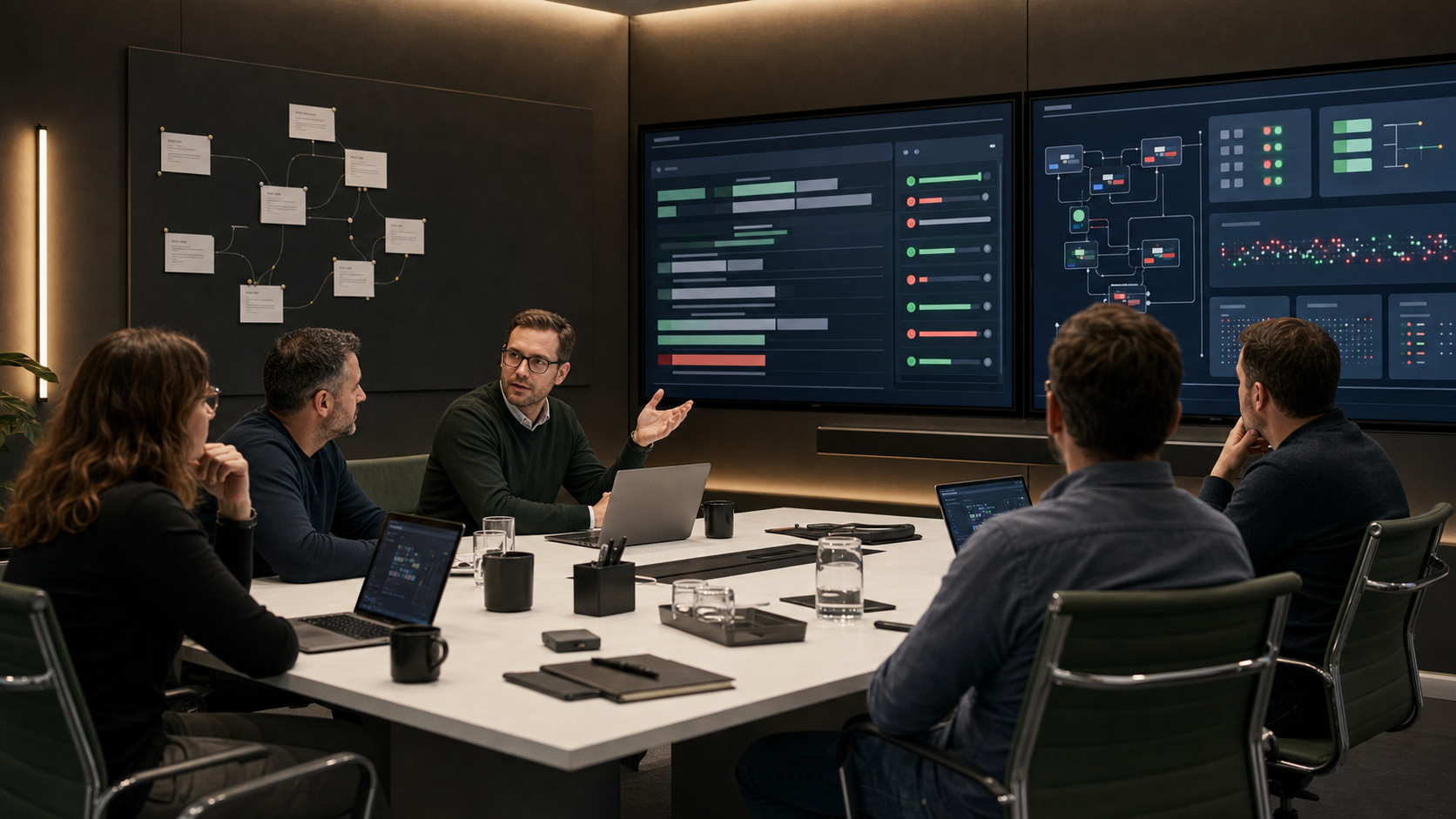
Over the last day, X has had a very practical version of that discussion. Developers are talking less about individual prompts and more about fleets of coding agents, parallel branches, preview environments, agent-native planning tools, automated review, context engineering, and the problem of keeping many autonomous workstreams pointed at one coherent product.
That is the right discussion.
Because AI coding agents do not automatically remove bottlenecks.
They move them.
Faster code creates pressure somewhere else
In a traditional software team, implementation is often the visible bottleneck.
A feature waits for a developer. A bug waits for someone to understand the affected area. A prototype waits for a spare afternoon. A refactor waits because the team is busy with roadmap work.
AI coding agents can genuinely reduce some of that waiting. They can draft changes, explore approaches, write tests, update documentation, build internal tools, and make repetitive implementation work much cheaper.
That is real value.
But software delivery is not just code production.
A serious product also needs:
- clear product intent;
- architecture boundaries;
- domain decisions;
- data modelling;
- integration planning;
- test strategy;
- review;
- security judgement;
- release management;
- operational ownership.
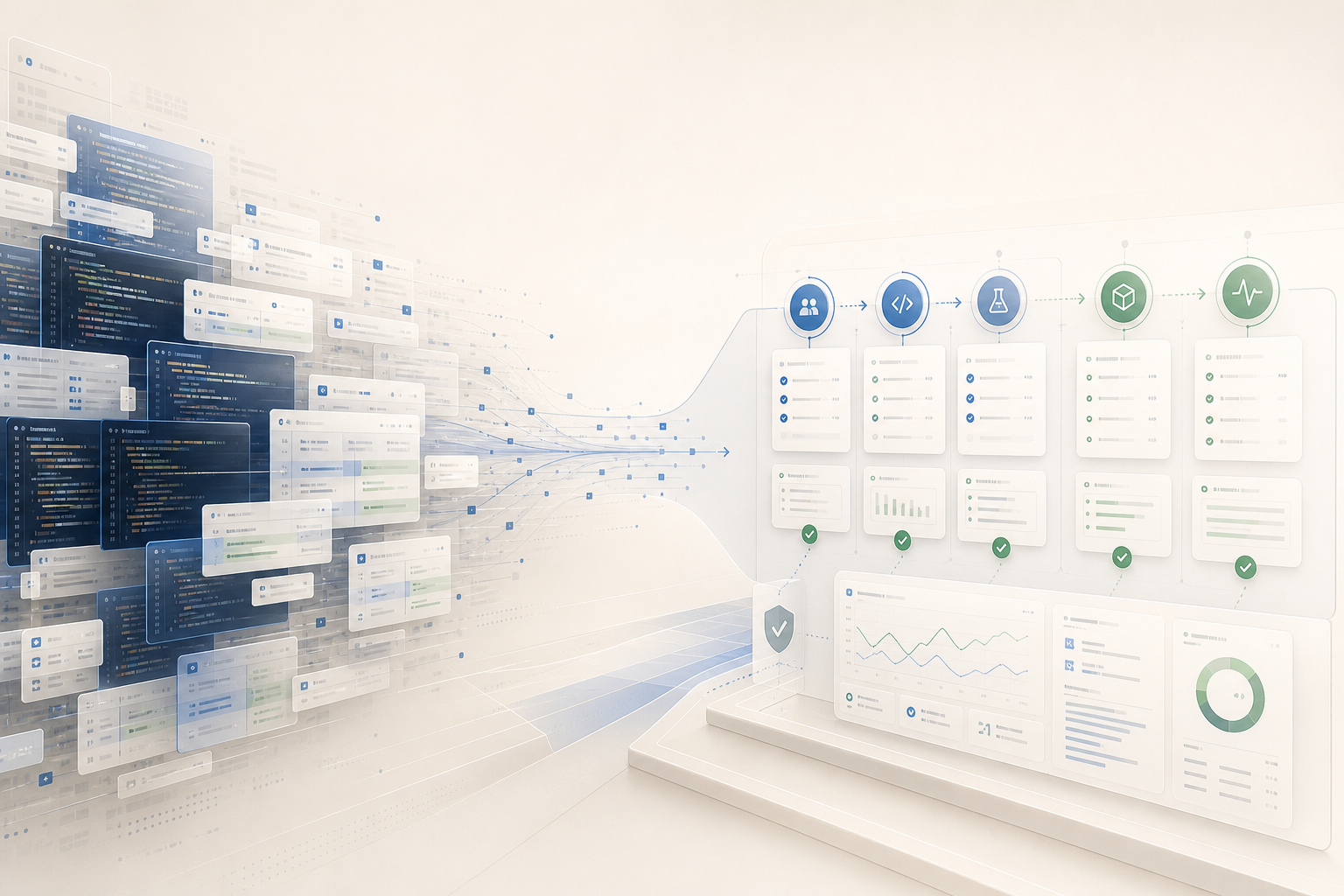
When agents make implementation faster, these other parts become more visible. The team may suddenly have five branches instead of one. Ten proposed changes instead of two. More prototypes than anyone has time to evaluate. More generated tests that still need a human to decide what risk they actually cover.
The team has more output.
But output is not the same as progress.
Progress means the right changes enter the product, fit the architecture, survive production, and remain maintainable after the excitement has passed.
The new bottleneck is coordination
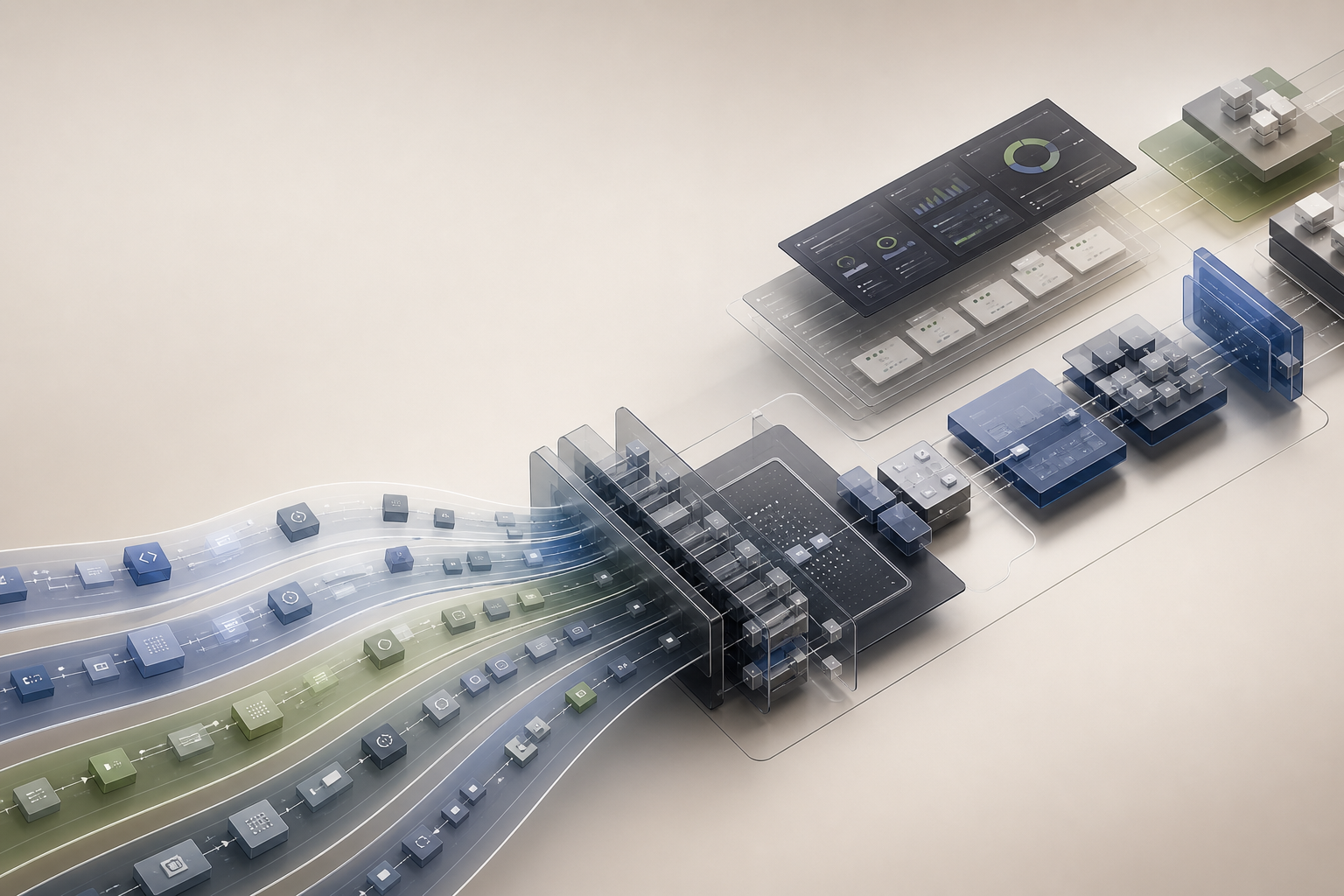
The emerging pattern is simple:
AI makes it easier to start work than to finish work well.
A founder can ask an agent to build three versions of a dashboard. A CTO can run parallel agents against different tickets. A product team can generate a prototype for every stakeholder idea. A developer can send an agent through a backlog of small fixes.
The hard part is no longer always getting a first version.
The hard part is deciding:
- Which version should survive?
- Which branch is aligned with the product?
- Which generated code violates an architectural rule?
- Which dependency is unnecessary?
- Which test is meaningful and which only proves the happy path?
- Which change should be split, delayed, or rejected?
- Which part of the system is becoming harder to operate?
This is coordination work.
It is planning, sequencing, review, integration, and judgement. It is the work that turns possible code into product-quality software.
That is why the current X discussion around agent orchestration matters for clients. It is not just a tooling trend. It is a sign that teams are running into the next layer of reality.
If agents can create code faster than the organisation can understand, review, and integrate it, the bottleneck has not disappeared.
It has moved from the keyboard to the operating model.
Why this matters for founders
Founders are especially exposed to this trap.
AI tools make it possible to build impressive prototypes quickly. That can be excellent. A founder can test a workflow, show a customer something tangible, explore an internal tool, or validate whether a product idea deserves more investment.
But fast prototypes create a dangerous temptation:
If the demo works, maybe the product is almost done.
Often it is not.
The prototype may have no clear permission model. The data model may be improvised. The error handling may be superficial. The integrations may depend on assumptions that will break under real use. The UI may cover the happy path but not the operational reality. The code may be good enough to show, but not good enough to own.
AI makes it easier to cross the demo line.
It does not automatically make it easier to cross the production line.
For a founder, the useful question is not “can we build this with AI?” In many cases, yes, at least partly.
The better question is:
What must be true before this becomes a dependable product?
That includes architecture, security, testing, maintainability, data protection, customer support, deployment, monitoring, and a clear understanding of which parts deserve human engineering judgement.
At McDougall Digital, this is exactly where we want AI-supported development to be useful: not as a shortcut around product responsibility, but as a way to move faster while still making the decisions that a serious product needs.
Why this matters for CTOs and product owners
For CTOs and product owners, the coordination problem shows up differently.
The team may already have a product, customers, production incidents, technical debt, and delivery commitments. AI agents do not enter a blank canvas. They enter an existing system with habits, constraints, ownership boundaries, and history.
That makes unmanaged agent throughput risky.
If every developer runs agents independently, the team may get more local speed and less shared coherence. One agent creates a new helper where a pattern already exists. Another changes validation in one layer while the architecture expects it somewhere else. A third adds a dependency for a problem the platform already solved. A fourth updates tests but misses the business rule that actually matters.
None of those failures are dramatic in isolation.
Together, they create entropy.
This is why AI coding adoption should be treated as a delivery-system change, not only a tool rollout. The relevant questions become:
- How are tasks prepared for agents?
- What context do agents receive?
- Which repositories and paths are allowed?
- How are generated branches named, reviewed, and merged?
- Which changes require architecture review?
- Which tests must pass before human review?
- Who resolves conflicts between parallel agent outputs?
- How do product decisions get captured so agents do not rediscover them badly?
These are not abstract governance questions.
They are the difference between a team that gets leverage from AI and a team that gets more code to clean up.
The planning layer becomes more important
One useful signal in the current conversation is the rise of agent-native planning and orchestration tools.
Whether the specific tool is Lightsprint, AG Kit, 49 Agents IDE, a custom internal workflow, or something else is less important than the underlying need. Teams want a way to coordinate many agent tasks without turning the repository into a pile of disconnected guesses.
That planning layer needs to answer practical questions:
- What is the intended product outcome?
- Which agent should work on which bounded task?
- What files or modules are in scope?
- What is explicitly out of scope?
- What assumptions should be checked before implementation?
- What does “done” mean?
- Which review path should the output follow?
Without that layer, parallel agents can become parallel ambiguity.
The fastest team is not the one running the most agents.
It is the one that can define good work, divide it sensibly, preserve context, and integrate changes without losing the product’s shape.
Context engineering is not optional
AI coding quality depends heavily on context.
But context is not just “give the model more files.”
For real software teams, good context includes the current architecture, domain language, coding standards, testing strategy, deployment constraints, customer promises, security expectations, and known tradeoffs.
Bad context includes stale documents, contradictory tickets, outdated prototypes, noisy Slack threads, old architecture decisions that nobody follows, and broad repository access without a clear task boundary.
When agents are used occasionally, weak context is annoying.
When agents are used at scale, weak context becomes expensive.
Every unclear instruction creates review work. Every missing architectural rule creates rework. Every stale decision creates a chance that the agent faithfully implements the wrong thing.
This is one reason architecture-first delivery becomes more valuable in the AI era, not less. The clearer the system is, the better an agent can contribute without inventing its own structure.
Documentation also changes role.
It is no longer only for humans onboarding into a codebase. It becomes operational input for AI-assisted work. Short, current, specific documents can improve agent output more than long, forgotten strategy decks.
Review becomes a product function, not just a code function
When implementation gets cheaper, review becomes more strategic.
A reviewer is not only asking whether the code compiles. They are asking whether the change should exist, whether it fits the product, whether it respects customer reality, and whether it leaves the system easier or harder to own.
That means review must include product judgement.
For example:
- Does this generated workflow match how users actually work?
- Does it make the core path simpler or add another edge case?
- Does it hide a business rule inside UI code?
- Does it make support harder?
- Does it create a migration problem for existing customers?
- Does it introduce an operational dependency nobody owns?
These questions are not solved by running another agent.
Agents can help prepare review. They can summarize diffs, identify risky files, run checks, compare patterns, and suggest tests. But responsibility for the product still sits with the team.
This is where many AI adoption stories will split.
Some teams will use agents to produce more code and then drown in review.
Better teams will use agents to improve the whole delivery loop: clearer task framing, smaller diffs, better tests, faster feedback, stronger documentation, and more deliberate product decisions.
Integration is where the truth appears
Generated code looks best before it meets the rest of the system.
Integration is where assumptions become visible.
The agent used a slightly different data shape. The API contract had an undocumented rule. The migration works for new customers but not existing ones. The UI state is fine in isolation but breaks with real permissions. The test suite passes locally but misses the production edge case. The generated module duplicates a pattern from another part of the codebase.
This is normal software work.
AI does not remove it.
It can make it arrive faster.
That is why serious teams need stronger integration habits around AI-assisted development:
- small, bounded changes;
- preview environments for product review;
- automated tests that reflect real business rules;
- architecture checks for high-risk areas;
- clear merge ownership;
- feature flags where appropriate;
- observability after release.
The point is not to slow agents down.
The point is to make their speed usable.
What a serious operating model looks like
A practical AI-assisted delivery model does not have to be heavy.
It should be explicit.
For many teams, a good starting model looks like this:
First, classify the work.
Low-risk work might include copy changes, isolated UI adjustments, documentation updates, simple tests, and small refactors. Agents can handle much of this with lightweight review.
Medium-risk work might include new API endpoints, data model adjustments, business logic changes, integrations, and workflow changes. These need stronger task framing, tests, and product review.
High-risk work includes authentication, authorization, billing, tenant isolation, data migrations, production operations, security-sensitive integrations, and anything involving customer or employee data. Agents may still help, but the workflow needs clear boundaries and human ownership.
Second, prepare context before execution.
An agent should receive the goal, the relevant files, the architecture constraints, the non-goals, the test command, and the expected review path. Vague tasks produce vague diffs.
Third, keep changes small.
The best agent work is often narrow. One problem, one branch, one reviewable output. Large autonomous runs may look efficient, but they often push complexity into review and integration.
Fourth, measure outcomes.
Do not measure AI adoption by number of generated lines. Measure cycle time, review effort, defect rate, rework, delivery predictability, maintainability, and whether the team is making better product decisions faster.
Fifth, improve the system.
Every bad agent output is feedback. Maybe the prompt was unclear. Maybe the architecture is poorly documented. Maybe the task was too broad. Maybe the codebase has hidden coupling. Maybe the test suite does not express the business rule.
The goal is not only to blame or praise the agent.
The goal is to improve the delivery system around it.
The opportunity for German companies
German companies, especially Mittelstand businesses, often have a practical relationship with software.
Software is not a toy. It runs customer processes, internal operations, logistics, production planning, compliance workflows, reporting, service delivery, and commercial differentiation.
That makes the AI coding coordination question especially relevant.
The opportunity is not to copy every AI-native startup workflow blindly. The opportunity is to use AI where it creates leverage while keeping the seriousness that production software needs.
For example:
- prototypes can move faster without pretending they are finished products;
- internal tools can be built with clearer ownership and lower waste;
- legacy modernization can be approached in smaller, testable slices;
- documentation can become more useful because it serves both humans and agents;
- product teams can explore alternatives without committing to all of them;
- developers can spend less time on repetitive implementation and more time on architecture and judgement.
That is a strong opportunity.
But it requires discipline.
The companies that benefit most will not be the ones that simply run more agents. They will be the ones that connect agent speed to product clarity, architecture, review, operations, and business value.
The practical takeaway
AI coding agents are becoming good enough that the old bottleneck is changing.
That is good news.
But it also means founders, CTOs, and product owners need to stop treating AI-assisted development as a personal productivity trick. It is becoming part of the software delivery system.
The question is no longer:
Can an agent write this code?
The better questions are:
- Is this the right change?
- Is the task framed clearly enough?
- Does the agent know the architecture?
- Can the team review the output?
- Can the product absorb the change?
- Can operations support it?
- Will this still be maintainable in six months?
At McDougall Digital, we help teams answer those questions while still using AI to move faster. That means architecture-first delivery, practical product judgement, controlled AI-supported implementation, and operating models that make agent output useful rather than chaotic.
AI coding agents did not remove the bottleneck.
They moved it to the place where serious software teams already win or lose:
coordination, judgement, and the ability to turn code into a product people can rely on.
This article was created with the help of AI. McDougall Digital is responsible for its content.